You send the underwriter a clean-looking trucking risk. Three years in business, no losses on the app, decent equipment. The decline comes back in a day, and nobody tells you why. The answer, more often than not, is a CAB report you never saw.
So what is a CAB report? It is the document insurance companies pull on nearly every trucking submission before they decide to quote, question, or decline. This guide covers what the Central Analysis Bureau report contains, how underwriters read it, and how trucking insurance agents can review the same data before the submission goes in.
What Is a CAB Report?
CAB stands for Central Analysis Bureau, a data company that has served the trucking insurance industry for decades. A CAB report aggregates government and proprietary data on a single motor carrier into one document: authority history, safety performance, inspections, crashes, insurance filings, and operational details, presented with charts, alerts, and summaries.
CAB also scores each carrier monthly. Underwriters treat that score like a report card. It tells them at a glance which submissions to decline, which need more documentation, and which are clean enough to quote. Access is subscription-only, and the subscribers are insurance carriers, MGAs, and wholesale brokers. Most retail agents never see it.
What's Inside a CAB Report
The report pulls together most of what the federal government knows about a motor carrier, plus CAB's own analysis layered on top:
- Authority history. Operating and brokerage authority, including gaps, revocations, and reinstatements.
- Safety data. DOT safety rating plus the FMCSA's Safety Measurement System scores and alerts.
- Inspections and violations. Every roadside inspection and violation on a rolling 24-month window, including out-of-service events.
- Crash history. Reportable crashes with dates and severity.
- Derived unit count. CAB counts the distinct vehicles inspected over 24 months to estimate how many units the carrier actually runs, independent of what the application says.
- Insurance history. Filings, lapses, and flags for inadequate insurance.
- Connections. Other entities sharing the carrier's phone number, address, or email, which can signal related operations or a reincarnated carrier.
- VIN usage analysis. Whether each inspected vehicle was used before, during, or after the carrier's own recorded usage, a check for equipment interchange between authorities.
The 3 Red Flags Underwriters Look For
Underwriters are not reading every line. They scan for a handful of patterns that trigger questions or declines:
Unit count mismatch
The application says 5 trucks, but CAB's derived unit count shows 9 inspected in the last 24 months. That gap can mean trip leasing, unreported equipment, or broker authority exposure. Every one needs an explanation.
Equipment used "during" another carrier's operation
If a VIN shows inspections under another authority during the same period, the underwriter suspects interchanged equipment or a carrier operating under multiple authorities. This is the most concerning VIN descriptor on the report.
Shared phone, address, or email
Often harmless (permitting services file for hundreds of carriers), but it can also signal a related operation or a shut-down carrier restarting under a new DOT number. Underwriters dig until ownership is clearly separate.
One more thing worth knowing: inspections that do not belong to your insured can be challenged through the FMCSA's DataQs system. A successful challenge cleans up both the SMS profile and the CAB picture.
Why Agents Lose Deals to a Report They Never Saw
Here is the asymmetry. The underwriter has a monthly-scored dossier on your prospect. You have an application and whatever the carrier told you on the phone. When the two disagree, the data wins and the submission loses.
The fix is pre-underwriting. Most of what feeds a CAB report is public FMCSA data, the same census and inspection records that power DOT lead generation. An agent who checks the carrier's safety record, unit count, and authority history before submitting can do two things the competition cannot: walk away from unplaceable risks early, and present the placeable ones with the discrepancies already explained. Underwriters respond faster to submissions that answer their questions before they ask them.
Pre-Submission Carrier Checklist
- Authority: active, no unexplained gaps or revocations
- Safety: 24 months of inspections, violations, and OOS events reviewed
- Crashes: history pulled and explanations gathered
- Units: inspected vehicle count squares with the application
- Connections: shared contact info identified and explained
See What the Underwriter Sees, Before You Submit
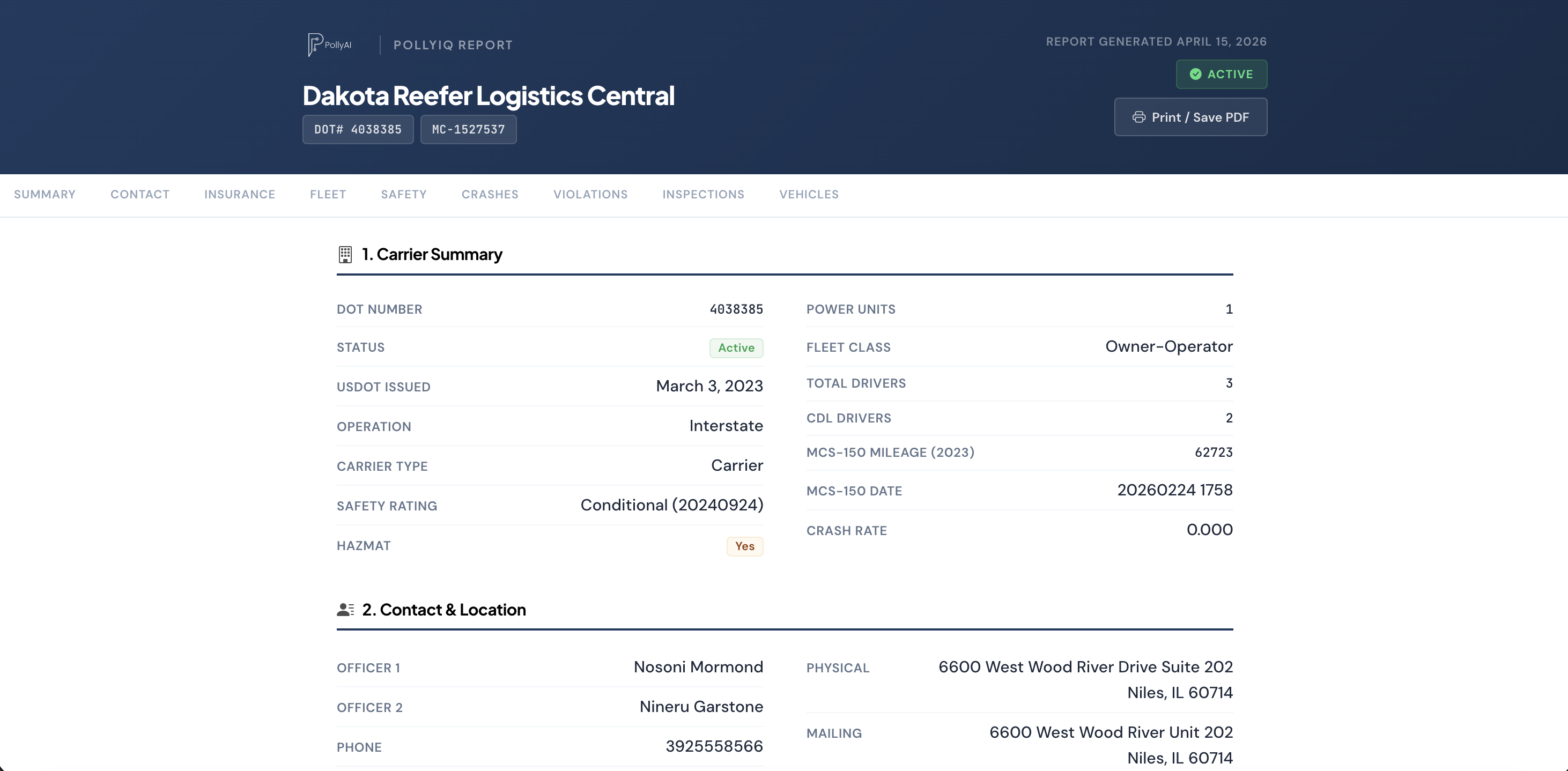
You do not need a CAB subscription to stop being surprised. PollyAI's carrier report builds a print-ready dossier on any motor carrier from the same public FMCSA data underwriters check: authority status, safety scores, 24 months of roadside activity, crash history, inspection citations, and equipment detail, all on one shareable page.
Agents use it two ways. Before the first call, it turns a cold prospect from a trucking insurance lead list into a risk you already understand. Before the submission, it becomes the attachment that shows the underwriter you have done the work, with red flags addressed in the cover note instead of discovered in review. Pair it with the prospecting engine from our truck insurance marketing playbook and the same data that finds the lead also qualifies it.
CAB Report FAQs
What is a CAB report in trucking insurance?
It is a motor carrier risk report from the Central Analysis Bureau that aggregates authority history, safety data, inspections, violations, crashes, and insurance filings into one scored document. Underwriters use it to vet trucking submissions.
Who can access CAB reports?
Only CAB subscribers, primarily insurance carriers, MGAs, and wholesale brokers. Retail agents typically cannot pull one, but the underlying FMCSA data is largely public and reviewable through tools like SAFER or a PollyAI carrier report.
How long do violations stay on a CAB report?
Roadside inspection violations stay on a rolling 24-month window. Clean operation for two years ages them off, and incorrect inspections can be challenged through DataQs.
How can agents see what underwriters see?
Pre-underwrite with public data. PollyAI's carrier report compiles authority, safety, crash, inspection, and equipment data into one view, included with every plan, starting at $39 per month.
Deciding between monitoring and prospecting tools for your book? Our Carrier411 alternative comparison breaks down the trade-offs.
Want more than the safety snapshot? Pull the full truck carrier report for the complete dossier before you quote.