The quote comes back with questions you did not expect, or it does not come back at all. When you ask why, the underwriter says the carrier "scored poorly." What they are usually talking about is a CAB score, the monthly grade the Central Analysis Bureau assigns to nearly every active motor carrier. This guide explains what a CAB score measures, how it relates to the FMCSA numbers you can check yourself, and what trucking insurance agents can do about a score they are never shown.
What Is a CAB Score?
The Central Analysis Bureau is the data company behind the CAB reports underwriters pull on trucking submissions. Alongside the full report, CAB scores each carrier monthly, condensing the carrier's federal record into a grade an underwriter can read in seconds.
The score works like a credit score for motor carrier risk. It is built from the same government data anyone can look up, but packaged, weighted, and refreshed monthly so a desk underwriter can triage a stack of submissions without opening every safety profile. CAB does not publish the formula, and access is subscription-only: insurance carriers, MGAs, and wholesale brokers subscribe, retail agents almost never do.
CAB Score vs the Scores You Can Look Up Free
Agents hear "score" and think of the FMCSA's public numbers. They are related, but they are not the same thing, and mixing them up in front of an underwriter costs credibility. Three public measures matter:
Safety Measurement System percentiles
The FMCSA's Safety Measurement System ranks carriers against their peers across seven BASIC categories such as Unsafe Driving and Vehicle Maintenance. Percentiles above the intervention threshold trigger alerts. This is the closest public cousin to a CAB score, and it feeds the CAB report directly.
Inspection Selection System score
A 1 to 100 number roadside enforcement uses to decide whom to pull in. Higher means more likely to be inspected. It shapes how much fresh inspection data a carrier generates, which in turn keeps feeding every other score.
Safety rating from a compliance review
Satisfactory, Conditional, or Unsatisfactory, issued only after an FMCSA review, which is why most carriers are Unrated. Our guide to carrier safety ratings covers what each rating means for insurability.
The CAB score sits on top of all three. It is proprietary where they are public, monthly where the DOT rating is static, and holistic where each public score covers one slice of the record.
What Feeds a CAB Score
CAB keeps the recipe private, but the ingredients are known because they are on the report next to the score:
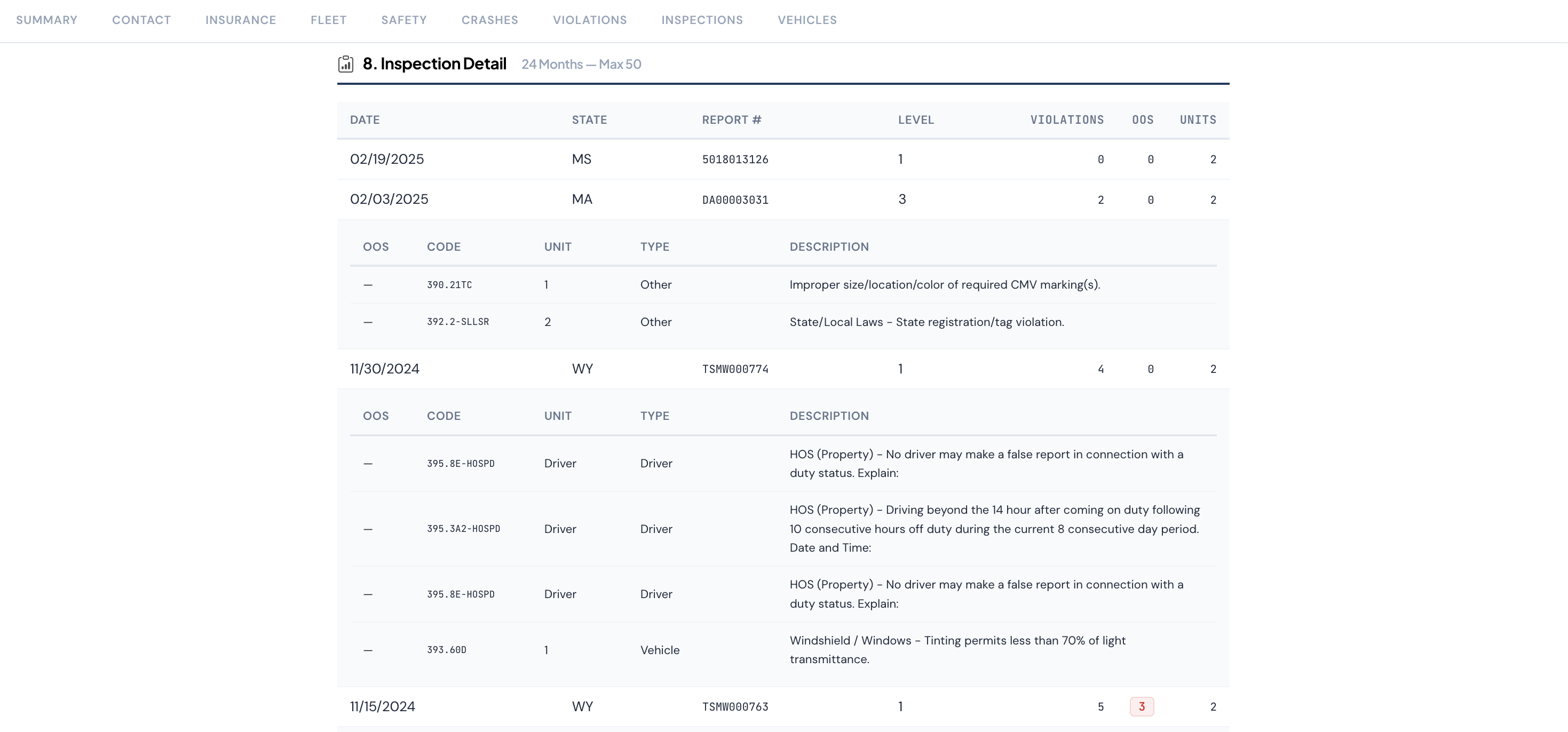
- Roadside inspections and violations over a rolling 24-month window, including out-of-service events and the severity of what was cited.
- Crash history, with dates and severity.
- Authority history, including gaps, revocations, and reinstatements.
- Insurance filings, especially lapses and flags for inadequate coverage.
- Fleet size signals, such as the count of distinct vehicles inspected, checked against what the carrier reports.
- Operational stability, including how long the authority has been active and whether contact details connect to other entities.
Two properties follow from that list. The score is backward-looking, so a carrier that cleaned up its operation still wears its old violations until they age off the 24-month window. And it is data-dependent, so an inspection recorded against the wrong carrier drags the score until someone challenges it through the FMCSA's DataQs system.
How Underwriters Use the Score
Volume explains everything here. A commercial auto underwriter might see dozens of trucking submissions a week. The CAB score is the sorting mechanism: strong scores move to quoting, weak scores get declined or parked, and the middle gets a list of questions sent back to the agent. That is why a submission can die in a day with no explanation. Nobody read your narrative, the score decided before the narrative mattered.
The score is also why two nearly identical applications get different receptions. On paper both carriers run five trucks with three years of authority. In the data, one has two clean inspections a year and the other has an out-of-service spike eight months ago. You cannot see that difference on the application. The underwriter cannot see anything else.
Working a Score You Cannot See
Agents do not need the score itself. They need the record that produces it, and that record is public. Pre-underwriting the carrier before submission turns the CAB score from an ambush into a known quantity:
Pre-Submission Score Check
- Pull the safety record: 24 months of inspections, violations, and OOS events
- Check SMS percentiles: any BASIC near or over the alert threshold needs a story
- Verify the fleet: inspected vehicle count should square with the application
- Review authority and filings: gaps and insurance lapses are score killers
- Flag bad data: wrong-carrier inspections go to DataQs before renewal season
PollyAI builds this into the prospecting workflow. Every carrier in the platform links to a print-ready truck carrier report assembled from the same public FMCSA data that feeds CAB: authority status, safety scores, 24 months of roadside activity, crash history, and equipment. Agents review it before the first call, attach it to the submission, and answer the score's questions in the cover note instead of two weeks later. It is included with every plan, starting at $39 per month.
CAB Score FAQs
What is a CAB score?
It is the monthly carrier score assigned by the Central Analysis Bureau, built from a carrier's inspections, violations, crashes, authority history, and insurance filings. Underwriters use it to triage trucking submissions.
What is a good CAB score?
CAB does not publish its scale or formula, and underwriters read the score in context. The practical answer for agents: a carrier with clean inspections, stable authority, and no insurance lapses over the last 24 months will grade well.
Can insurance agents check a CAB score?
Not directly. Access is subscription-only and sold to insurance carriers, MGAs, and wholesale brokers. Agents can review the public FMCSA data behind the score before they submit.
How does a carrier improve its CAB score?
By improving the record it measures. Violations age off after 24 months, sustained clean inspections rebuild the picture, and incorrect inspections can be challenged through DataQs. Nothing edits the score directly.
New to the underlying report? Start with our plain-English guide to CAB reports linked above, then come back to the score once you know what the document contains.