A prospect tells you they run "about five trucks." The application says five. The FMCSA record says nine. One of those numbers is going to set the premium, and it is not the one the carrier gave you on the phone. That number traces back to a single federal form: the MCS-150.
So what is an MCS-150? It is the form every motor carrier files with the FMCSA to register and to keep its record current, and it is the source of most of the carrier data agents and underwriters rely on. This guide breaks down what the MCS-150 reports, the biennial schedule that keeps it fresh, and how trucking insurance agents turn that data into prospecting and quoting decisions.
What Is an MCS-150 Form?
The MCS-150 is the Motor Carrier Identification Report. A carrier files it to obtain a USDOT number, and the same form is updated over the life of the operation. The FMCSA uses it to build and maintain its census of motor carriers, which is the master record behind safety monitoring, the SAFER lookup, and the public data files that feed lead tools. The official form and instructions live on the FMCSA registration page.
For an insurance agent, the MCS-150 matters for one reason: it is self-reported by the carrier and then made largely public. That means you can read the same operational profile the carrier submitted to the government, before you ever pick up the phone.
What the MCS-150 Reports
The form captures the operating profile of the carrier. The fields that matter most for prospecting and rating are:
- Legal name and DBA. The registered entity plus any "doing business as" name.
- Principal address and contact. Physical location, mailing address, and phone, the starting point for any outreach.
- USDOT number. The unique identifier that ties every other federal record to the carrier.
- Power units. The count of trucks and tractors the carrier operates, the single most-used number for sizing a fleet and a premium.
- Drivers. Total drivers, including how many are CDL holders and how many cross state lines.
- Operation classification. Authorized for-hire, private, exempt, and similar designations.
- Cargo classifications. The commodity types the carrier hauls, from general freight to reefer, flatbed, or hazmat.
- Hazmat detail. Whether the carrier transports placarded hazardous materials.
- Annual mileage. Total miles for the most recent year, a rough proxy for exposure.
Put together, those fields describe the risk: how big, what they haul, how far they run, and where they sit. It is the skeleton of an underwriting file, filled out by the carrier itself.
How Often Carriers Update the MCS-150
The MCS-150 is not a one-time filing. Carriers must update it every two years, even when nothing changed. This is the "biennial update," and it runs on a schedule tied to the USDOT number rather than the calendar year everyone shares.
Sets the month to file
The final digit of the USDOT number maps to a month. A number ending in 1 files in January, ending in 2 files in February, and so on through the year.
Sets odd or even year
If the next-to-last digit is odd, the carrier updates in odd-numbered years. If it is even, they update in even-numbered years. The result is a steady, predictable two-year cycle.
Triggers an off-cycle update
A move, a change in fleet size, a new cargo type, or ceasing operations all require a fresh filing right away, not at the next biennial date.
For agents, the cadence is the opportunity. A carrier that just refiled has confirmed its fleet size and contact details are current. A brand-new USDOT registration is the freshest signal of all, an operation that needs insurance and does not yet have an incumbent agent defending the account.
Why the MCS-150 Matters to Insurance Agents
The data wins arguments, and on a trucking submission the MCS-150 is where the data comes from. Three uses stand out.
Sizing the risk before the call. Power units, mileage, and cargo type tell you whether a prospect is worth your time and roughly where the premium will land. You walk into the conversation already knowing the shape of the account.
Catching the discrepancies underwriters catch. When the application says five trucks and the census shows nine, you want to find that gap first. Reviewing the carrier's reported power units against inspection activity is the same pre-underwriting move that keeps clean submissions from getting declined, the same logic behind reading a CAB report before you submit.
Timing the outreach. New DOT registrations and biennial refilings are timing signals. Reaching a carrier when it is registering, or in the window before its insurance renews, beats showing up cold months after a competitor bound the policy. That is the core of prospecting new trucking authorities.
What the MCS-150 Tells You at a Glance
- Fleet size: power units to size the premium
- Operation: for-hire, private, cargo types, hazmat status
- Exposure: annual mileage and driver count
- Freshness: registration and biennial update dates
- Contact: address and phone to start the outreach
Turning MCS-150 Data Into Leads
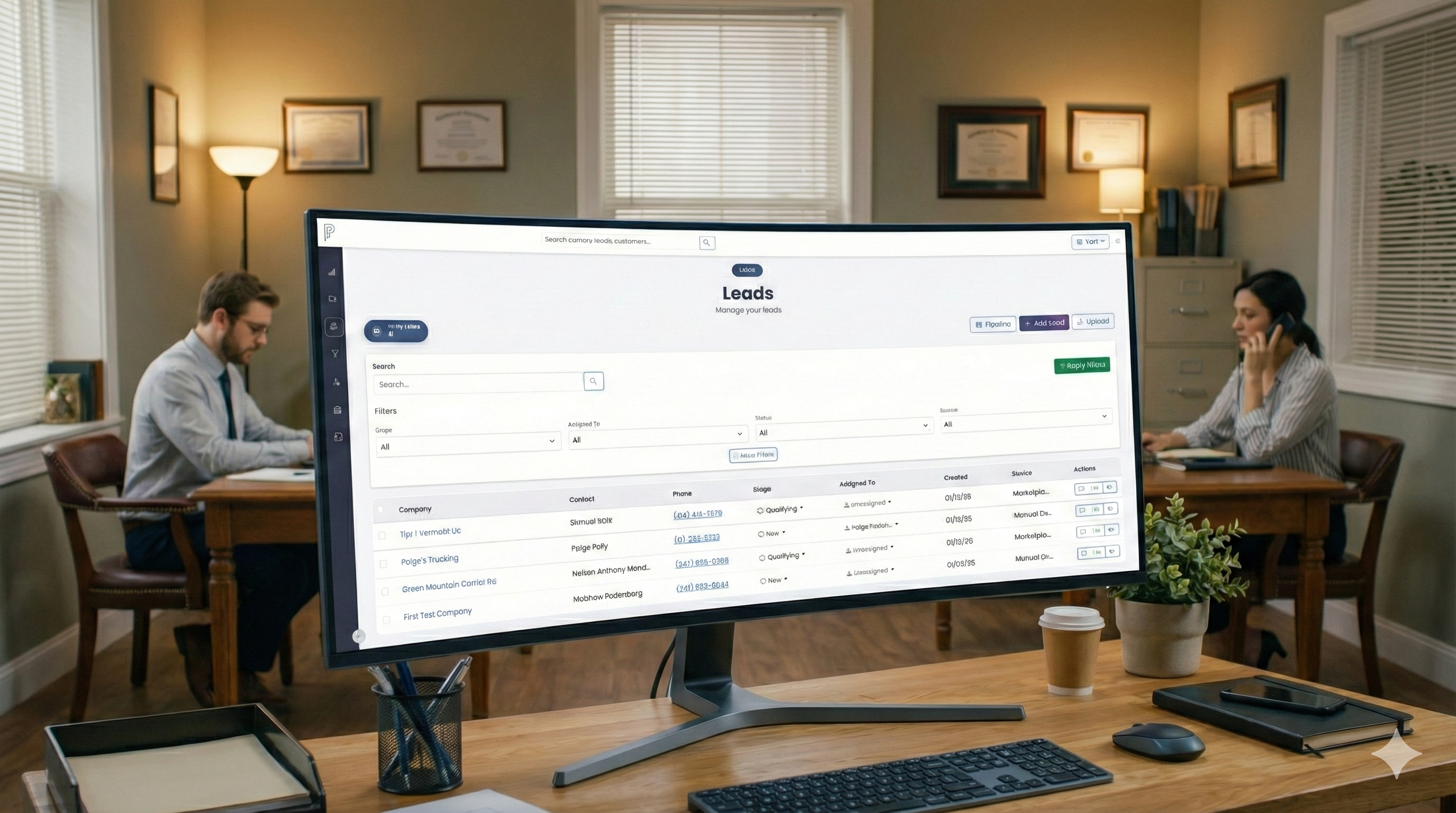
Reading one carrier's MCS-150 is useful. Reading every carrier's at once, filtered to the ones you can write, is a prospecting engine. PollyAI pulls the public FMCSA census into a single filterable database, so instead of looking up DOT numbers one at a time you sort the whole market by state, power units, cargo type, and registration date.
That turns the form into a workflow. Filter for new authorities in your state, build a list of carriers in your sweet-spot fleet size, and launch outreach from your own domain, all before the morning is over. It is the same engine behind our DOT lead generation and the broader truck insurance marketing playbook. The MCS-150 is the raw material. The list is what you sell from.
MCS-150 FAQs
What is an MCS-150?
It is the Motor Carrier Identification Report, the FMCSA form a carrier files to get a USDOT number and keep its record current. It reports name, address, power units, drivers, cargo types, operation class, and annual mileage, the data that fills the public FMCSA census.
How often does a carrier have to file an MCS-150?
Every two years on a biennial schedule, even when nothing changed. The next-to-last digit of the USDOT number sets odd or even years, and the last digit sets the month. Carriers also refile whenever fleet size, address, or operation changes.
What is the difference between an MCS-150 and a biennial update?
They are the same form. The biennial update is the recurring filing of the MCS-150 every two years. A carrier files its first MCS-150 at registration, then updates that form on schedule or whenever the operation changes.
Where can insurance agents find MCS-150 data?
Most fields are public through SAFER and the FMCSA census files. PollyAI organizes that data into a filterable lead database, included with every plan, starting at $39 per month, so you can sort carriers by state, fleet size, and registration date.