Bottom Line
Buy per-lead (shared or exclusive internet leads) if you need quote-ready prospects this week and accept that speed-to-call decides who wins the account.
Subscribe to the data (an FMCSA-based platform) if you are building a book. You trade quote-ready intent for exclusivity, unlimited volume, and renewal-date targeting that per-lead vendors cannot sell you.
The rest of this guide compares the main options in both camps, including our own product, PollyAI. We make one of the tools reviewed here, so take the bias seriously and check every claim yourself.
Search for the best trucking insurance leads and you will find two completely different products wearing the same label. One is the per-lead model: a carrier fills out a quote form somewhere, and that record is sold to you (and usually to several competitors) for a per-lead fee. The other is the data model: you subscribe to the motor carrier universe itself, sourced from FMCSA registration and safety data, and generate your own leads by filtering and reaching out.
Most "best leads" roundups ignore that split and rank ten lead brokers against each other. That misses the real decision. So this guide starts with the split, scores the models on the 5 factors that decide your cost per bound policy, and then walks through the specific vendors trucking insurance agents evaluate most in 2026.
Two Ways to Buy Trucking Insurance Leads
Model 1: Per-lead (shared, exclusive, or aged)
Lead vendors run advertising, capture quote requests, and resell them. Shared leads go to multiple agents at once, so your close rate depends heavily on calling first. Exclusive leads cost several times more per unit. Aged leads (30, 60, 90 days old) are cheap because the buying moment has usually passed. The model's strength is real: the prospect asked for a quote. Its weakness is structural: you never own the pipeline, the per-lead meter never stops running, and the same vendor is often feeding your competitor across town.
Model 2: Data subscription (FMCSA-based platforms)
Every for-hire motor carrier in the country registers with FMCSA, and that census (authority status, fleet size, cargo, safety record, insurance filings) is the raw material for a different kind of prospecting. Data platforms package it with filters, contact details, and freshness updates. Nobody "sells you a lead"; you build lists of carriers that match your underwriting appetite (new authorities this week, renewals 60 days out, 5 to 20 power units hauling reefer) and do the outreach yourself. Every reply is exclusively yours.
The 5-Point Scorecard
Whatever you evaluate, score it on these 5 factors. They are the ones that move cost per bound policy.
- 1. Exclusivity. How many other agents received this same prospect? Shared leads: several. Data-platform outreach: zero.
- 2. Freshness. New authorities are most winnable in their first weeks, and renewals in their last 60 days. Ask exactly how often the vendor's data updates.
- 3. Filtering depth. Can you target by state, fleet size, cargo type, equipment, safety history, and insurance expiration date? Depth here is what turns a list into a book strategy.
- 4. Outreach included. A list without a delivery mechanism becomes a second software purchase. Does the product send campaigns from your own domain and track replies, or does it stop at the CSV?
- 5. Price transparency. Can you see the full cost on a public page and sign up yourself, or does the number live behind a demo call?
The Best Trucking Insurance Leads Options in 2026, Compared
Shared and aged internet lead vendors
The generic commercial-lead marketplaces sell trucking quote requests per lead, priced by state and lead type. They score high on intent (the prospect asked for a quote) and low on everything else: exclusivity is the exception, filtering is limited to basic geography and line of business, outreach is your problem, and quality varies enough that dispute policies are a standard part of the purchase. If you use them, use them as a bridge while you build an owned pipeline, and track your true cost per bound policy honestly, including the hours spent racing other agents to the phone.
Carrier Software (DOT Leads)
The longest-tenured name in FMCSA-based lead data. Its DOT Leads product sells motor carrier records priced by lead type (Interstate, Intrastate, New Ventures) and by state, with no long-term contracts; specific pricing is quoted rather than published. The data lineage is solid and the product is proven. The gaps for a modern agency workflow: outreach is not built in, and you assemble the campaign stack yourself. Our full Carrier Software comparison covers it head-to-head.
CarrierOk
A clean, modern interface over carrier data with strong search and vetting features, used by both brokers and insurance-side teams. Pricing is not published on a public page, so evaluating total cost means a sales conversation. Like most data tools, it stops at the list: email campaigns and pipeline tracking happen in other software. Our CarrierOk comparison goes deeper.
Carrier IQ
Built specifically for trucking insurance lead generation, with carrier data and prospecting workflows aimed at the same agent audience PollyAI serves. It is a credible direct competitor. The differences that matter in an evaluation: pricing is behind a demo rather than published, and you should compare carrier-profile depth (equipment detail, out-of-service history, expiration dates) on your own states. Our Carrier IQ comparison walks through it feature by feature.
PollyAI
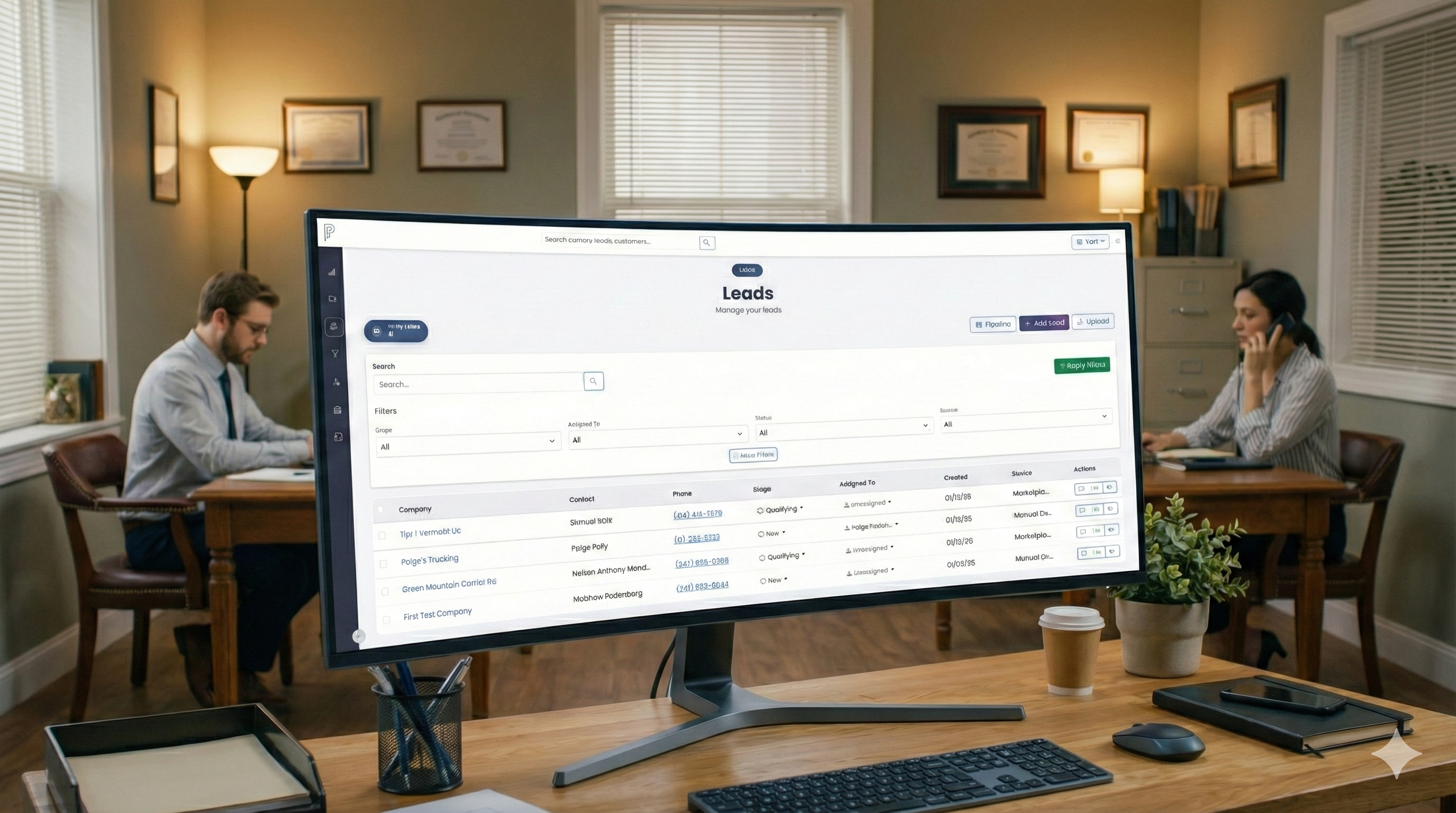
Our product, so grade this section hardest. PollyAI is an FMCSA-native lead generation platform: subscribe to the states you write business in, filter every active carrier by fleet size, cargo, equipment (VIN-decoded), out-of-service history, and insurance expiration date, then run email outreach from your own domain (connect your Outlook or Gmail inbox) and track every lead to bound policy in one pipeline. Pricing is public: $39 per month base plus $40 per month per state bundle, month to month, self-serve signup, no per-lead fees. What PollyAI does not do: sell you quote-ready inbound leads. The prospects have not asked for a quote yet; the platform's job is making your outreach fast, targeted, and exclusive.
Side-by-Side Comparison
| Factor | Shared lead vendors | Data vendors (DOT Leads, CarrierOk, Carrier IQ) | PollyAI |
|---|---|---|---|
| Exclusivity | Shared by default | Yes, you build the list | Yes, you build the list |
| Prospect intent | High (quote requested) | Cold, you create the demand | Cold, you create the demand |
| Renewal-date targeting | No | Varies by vendor | Yes, insurance expiration on every carrier |
| Filtering depth | State and line only | Yes, varies by vendor | Yes, incl. VIN-decoded equipment and OOS history |
| Outreach from your own domain | No | Not built in | Yes, campaigns with reply tracking |
| Pipeline to bound policy | No | Separate software | Yes, built in |
| Public pricing | Varies | Quoted, not published | Yes, $39 base + $40 per state |
| Cost model | Per lead, meter always running | Subscription or per-list | Flat subscription, unlimited lists |
Pricing in Plain Numbers
Per-lead math compounds fast. If a shared trucking lead costs $30 to $75 (typical quoted ranges vary by state and vendor) and closes at a few percent under multi-agent competition, one bound account can absorb $500 or more in lead spend before commission ever arrives. That is not a scandal, it is the model, but you should do that arithmetic with your own close rate before committing to it as your primary channel.
The subscription math is simpler. PollyAI is $79 per month all-in for a single-state agent ($39 base + $40 state bundle), with every active carrier in the state, unlimited list building, campaigns, and pipeline included. Two states run $119 per month. The numbers are on the pricing page, and there is no quote call between you and them. Competing data vendors quote pricing through sales conversations, so get their number for your states and put it in the same spreadsheet.
Which Should You Choose?
Buy per-lead if
- You need quotable prospects this week, not this quarter
- You have the phone discipline to call within minutes, every time
- Your states have thin carrier density and outreach volume is hard to build
- You treat it as a bridge channel and track cost per bound policy honestly
Subscribe to the data if
- You are building a trucking book for the long haul
- You want exclusive leads no competitor also received
- You prospect by renewal window, new authority date, and underwriting profile
- You want list, outreach, and pipeline in one monthly price
How to Test a Lead Source in 14 Days
- Days 1-2: define the target. One state, one underwriting profile (for example 5 to 20 power units, dry van or reefer, authority active 6+ months, renewal inside 60 days).
- Days 3-10: run both models on that target. Buy a small batch of per-lead prospects in the state, and build the same profile as a filtered list in a data platform, then send a short outreach sequence from your own domain.
- Days 11-14: count what matters. Conversations started, quotes released, and projected cost per bound policy. Not clicks, not "contacts delivered."
Our trucking insurance leads resource covers the data-platform side of that test in detail, and the DOT leads guide explains exactly what FMCSA data does and does not include.
Frequently Asked Questions
What are the best trucking insurance leads?
It depends on the model you want. Shared internet leads deliver quote-ready prospects but sell the same prospect to multiple agents. FMCSA data platforms let you build exclusive lists from the full motor carrier census, filtered by renewal window, fleet size, and cargo. Agents building a long-term book generally get more from owning the data than renting the lead.
What is the difference between shared leads and FMCSA data leads?
A shared lead is one quote request resold to several agents. An FMCSA data lead is a carrier you selected yourself from the federal census, with fleet, safety, and insurance expiration detail attached. The first has intent but competition; the second is exclusive but cold until your outreach warms it.
How much do trucking insurance leads cost?
Per-lead pricing varies by vendor, state, and lead type, and most data vendors quote through sales calls. PollyAI publishes its pricing: $39 per month base plus $40 per state bundle, so one state costs $79 per month with unlimited list building and no per-lead fees.
Can I get exclusive trucking insurance leads?
Yes, by generating them yourself. Filter FMCSA carrier data to your underwriting profile and run your own outreach; every reply is exclusively yours because the lead did not exist until your email created it.
Is PollyAI a lead provider or a data platform?
A lead generation platform. PollyAI combines FMCSA carrier data for your subscribed states, email campaigns sent from your own domain, and pipeline tracking from first touch to bound policy. You generate the leads; PollyAI supplies the data and the workflow.
Generate Your Own Exclusive Leads
$39 base + $40 per state bundle. Every active carrier in your states with VIN-decoded equipment, OOS history, and insurance expiration dates, plus outreach from your own domain and pipeline tracking. No per-lead fees, no sales call.
Start Building ListsMore reading: Trucking Insurance Leads, Explained · DOT Leads, Direct from FMCSA · PollyAI Pricing
Comparing specific vendors? Start with our head-to-head pages: Carrier Software, CarrierOk, and Carrier IQ.